Prepare the next decision
Summaries, suggested priority and category, approved-knowledge matches, and editable drafts reduce the setup work before a reviewer can act.
Prioritize the queue, let AI prepare repetitive support work, keep human judgment at the send step, and prevent the same SaaS questions from returning.
Faster preparation helps only when the team also fixes ownership, knowledge, escalation, and the causes of repeat work.
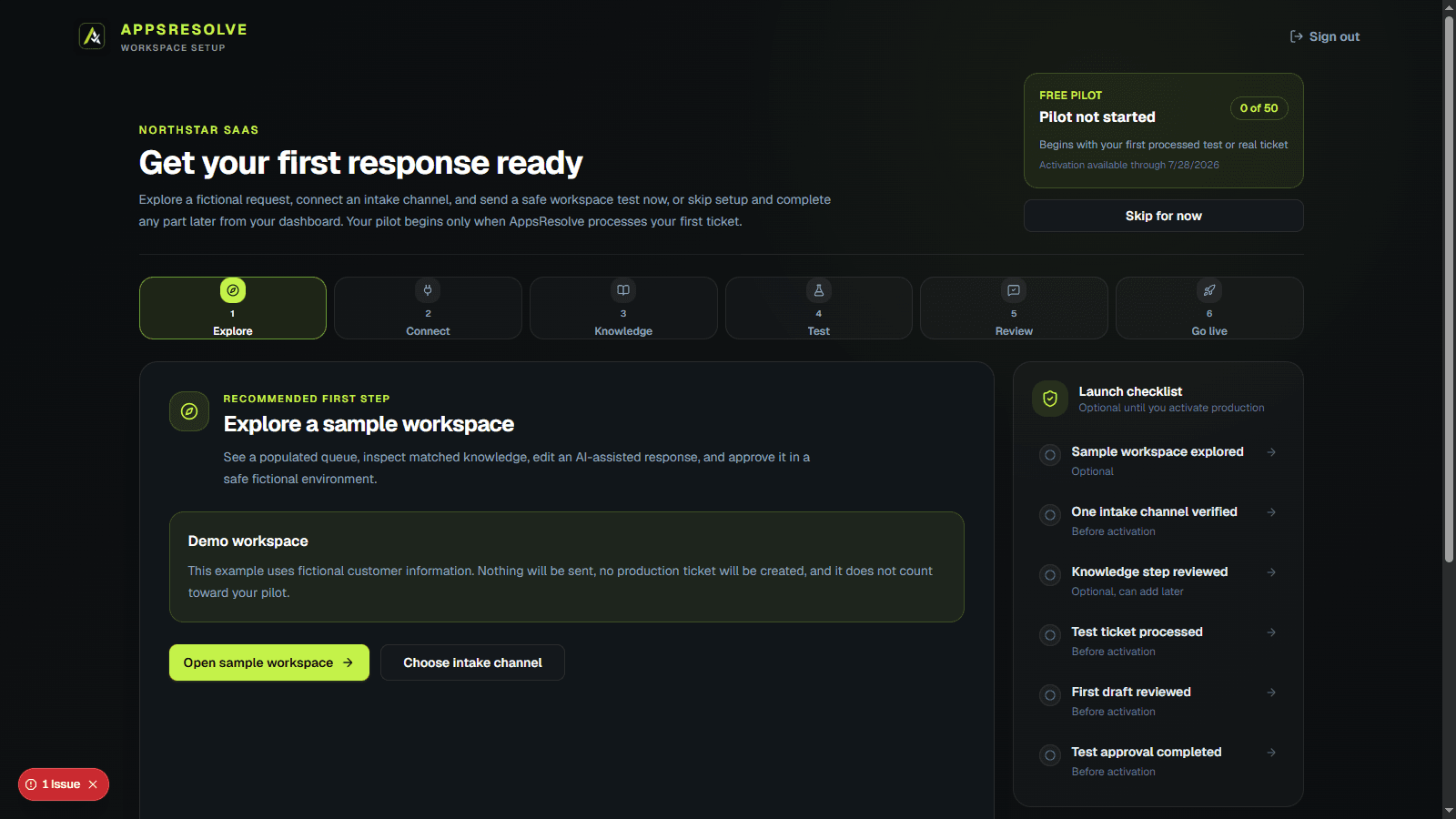
Fictional setup workspace. Teams can practice the review flow before activating production intake.
Summaries, suggested priority and category, approved-knowledge matches, and editable drafts reduce the setup work before a reviewer can act.
No draft leaves AppsResolve because a confidence score is high. A person verifies the answer, edits it, escalates it, or writes manually.
Correction reasons, reopened work, documentation gaps, and bug reports point to the articles and product problems that keep refilling the queue.
Each step preserves the customer request, organization, evidence, and human decision.
Define one queue, one owner, urgent categories, and a customer communication rule for delayed work.
Separate safe documented questions from account-risk, security, data, billing, and suspected product issues.
Use AI to summarize, classify, retrieve approved knowledge, and draft the next response.
Let a person verify the source, customer context, requested action, and final wording.
Update knowledge, clarify product behavior, or escalate a confirmed recurring cause instead of closing the same symptom repeatedly.
Backlogs usually combine several problems: unclear ownership, messages spread across channels, incomplete customer context, long technical threads, missing documentation, risky account actions, and engineering dependencies. Adding an AI reply generator to that mix does not fix routing or authority.
Older tickets deserve attention, but security concerns, data loss, blocked production workflows, failed payments, and multi-customer defects may need to move first. Define an escalation matrix and communicate with delayed customers rather than silently sorting only by arrival time.
The highest-leverage early automation is the work before the customer response: summarize the thread, identify the product area, retrieve the approved source, draft a safe starting point, and list missing information. That shortens review without allowing the model to represent the company independently.
Backlog pressure makes plausible AI mistakes more dangerous because reviewers are tempted to scan quickly. AppsResolve requires an authorized person to initiate the final reply. Security, billing, data, privileged account changes, and uncertain product behavior should receive deeper review regardless of draft fluency.
Work one class of tickets at a time. Resolve documented low-risk questions, request missing evidence in a consistent batch, move confirmed defects into structured engineering reports, and assign a named owner to blocked work. Track what is waiting on the customer, support, or engineering so the open count does not hide the bottleneck.
Review why drafts were corrected, which tickets reopened, where knowledge was missing, and which product issues repeated. Turn stable answers into approved articles and turn verified defects into product work. A cleared queue without a prevention loop is only a temporary reset.
AppsResolve prepares and organizes support work, but the person operating the queue remains responsible for the response and any promised action.
Centralize the queue, assign ownership, prioritize by consequence, batch similar work, use approved knowledge, prepare replies efficiently, create clear engineering handoffs, and fix the causes of repeat volume.
No. AI can prepare the analysis and draft, but an authorized person must review and initiate every customer response.
Published paid plans include a temporary 10 percent continuity buffer. Automatic AI processing then pauses, while incoming tickets, history, and manual replies remain available.
No. Age matters, but security, data loss, broad impact, blocked production use, and other high-consequence issues may need priority.
When support lacks structured diagnosis and escalation, engineers repeatedly reread conversations, ask for missing details, and handle customer communication. Better ticket preparation reduces that interruption.
Track corrections, reopened work, knowledge gaps, and repeated product problems, then assign documentation, product, onboarding, or support-process improvements with owners.
Add scoped operating capacity when the workflow exists but the team cannot own the queue consistently.
Read moreSeparate response work, diagnosis, privileged actions, and product engineering.
Read moreCompare internal hiring with a defined external operating scope.
Read moreThe agent answers from approved knowledge. Unknown questions become tickets. Suggested knowledge never publishes itself.