
Unify email and widget intake
The website agent answers from approved knowledge. Unknown questions and email requests arrive in one tenant-scoped queue for a person to handle.
Put an AI agent on your website, escalate what it cannot solve into tickets, and keep a person responsible for email replies and published knowledge.
The website agent answers from approved knowledge. A person still reviews ticket replies and suggested answers.
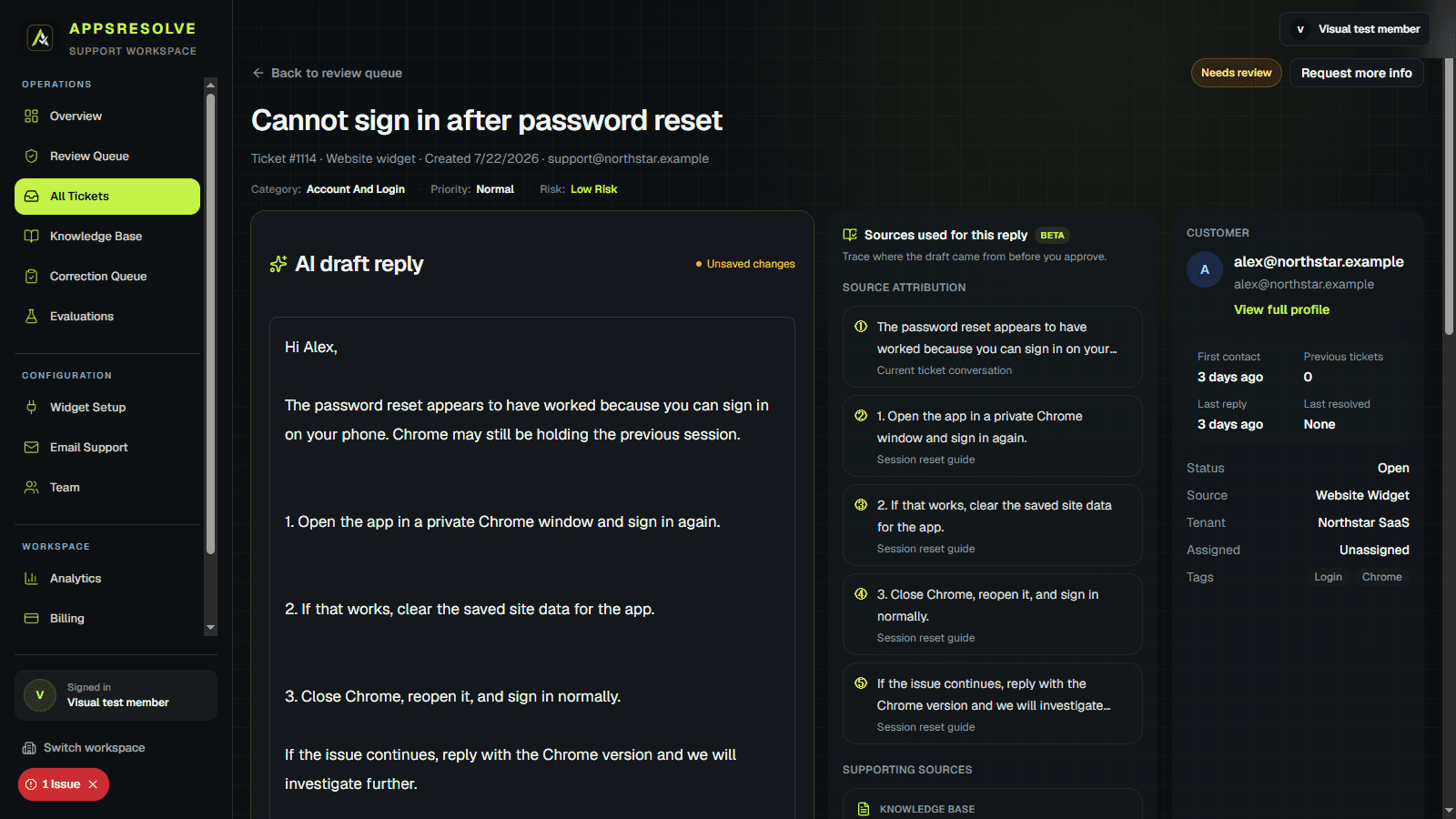
Fictional ticket review. AI prepares the draft; a person still reviews sources and initiates every send.
The website agent answers from approved knowledge. Unknown questions and email requests arrive in one tenant-scoped queue for a person to handle.
AI can summarize the thread, suggest category and priority, retrieve approved knowledge, identify gaps, and prepare an editable response.
A reviewer checks the conversation and sources, edits when needed, and explicitly approves the final reply before delivery.
Each step preserves the customer request, organization, evidence, and human decision.
A visitor asks the website agent, searches help, or emails support.
The agent answers from approved knowledge or says it does not know instead of inventing a policy.
Unknown questions and email requests become tenant-scoped tickets with the conversation and sources attached.
An authorized member verifies the facts, edits the draft, requests details, or escalates further.
Resolved work can suggest reusable knowledge. A person still approves it before it becomes searchable.
Small SaaS teams lose time copying requests between inboxes, summarizing long threads, searching several documents, rewriting familiar steps, and turning vague symptoms into engineering notes. Those are preparation tasks with repeatable structure. AppsResolve automates that preparation so the reviewer can spend more time checking product truth, making the support decision, and communicating clearly.
A fluent draft is not proof that the answer is correct or that support is authorized to take the requested action. Account access, billing changes, security concerns, data loss, possible defects, and unclear product behavior need judgment. AppsResolve keeps the source conversation, retrieved knowledge, and editable draft together, but it does not let a confidence score authorize sending.
AppsResolve is designed around customer-facing application support: sign-in problems, billing questions, configuration, APIs, integrations, exports, and suspected product errors. It does not currently provide IT asset management, device inventory, change management, procurement, or a broad employee-service catalog. Teams needing full ITSM should choose a platform built for that job.
Every ticket, message, knowledge source, widget request, member, and billing state belongs to an organization. Routes and queries resolve the authenticated membership or trusted inbound alias on the server. The product uses tenant-scoped application queries and database isolation controls so one customer's queue is not treated as global support data.
A new workspace can crawl a website, install the widget, ask a known question, ask an unknown question, inspect the conversation, and review any ticket before activating production. The public demo uses the same workspace and widget UI with sample data.
On self-service plans, the SaaS company's own members operate the review queue. Managed support can add an AppsResolve specialist under an agreed scope, while the customer retains workspace visibility and ownership. The software page and managed-service scope stay separate so teams know who is responsible for day-to-day replies.
AppsResolve is deliberately different from an autonomous AI agent. It can prepare a strong starting point and organize the queue, but the outbound provider is called only after an authorized reviewer submits the final response.
It is a customer-support system that can answer website questions from approved knowledge, turn unknowns into tickets, retrieve sources, prepare email drafts, and keep a person responsible for ticket replies and published answers.
The website agent can answer from approved knowledge. Email and ticket replies still require an authorized person to review and send. There is no auto-send threshold based on confidence.
The current product supports the AppsResolve website widget, including Ask AI, and forwarded customer-support email. Deep synchronization with every third-party help desk is not part of the current release.
Common examples include account access, billing questions, configuration, data imports and exports, API or webhook behavior, integrations, documented troubleshooting, and suspected application defects.
The website agent refuses to invent a business-specific answer and can open a ticket. A reviewer can inspect the conversation and sources, edit a draft, request more information, or write a manual response.
Yes. The platform is multi-tenant. Tickets, members, knowledge, email aliases, widgets, and billing are associated with an organization, while platform administrators use a separate operational view.
Yes. The public demo uses the real dashboard and widget with sample data. A new workspace can crawl a site, test Ask AI, inspect conversations, and activate production only after those checks pass.
Explore the reviewer queue, confidence context, drafts, and threaded customer replies.
Read moreUse a practical framework for deciding which work to automate and which actions to retain.
Read moreGive customers Ask AI, knowledge search, and a structured ticket path inside the product.
Read moreThe agent answers from approved knowledge. Unknown questions become tickets. Suggested knowledge never publishes itself.