Keep categories attached
AI-prepared category and priority stay with the ticket so reviewers can validate the label instead of rebuilding reporting context later.
Use support categories, reopened work, escalations, corrections, and documentation gaps to find the product issues and unclear guidance driving SaaS support volume.
AppsResolve exposes useful operational signals today. Automated multi-period trend charts and sentiment tracking are not yet shipped.
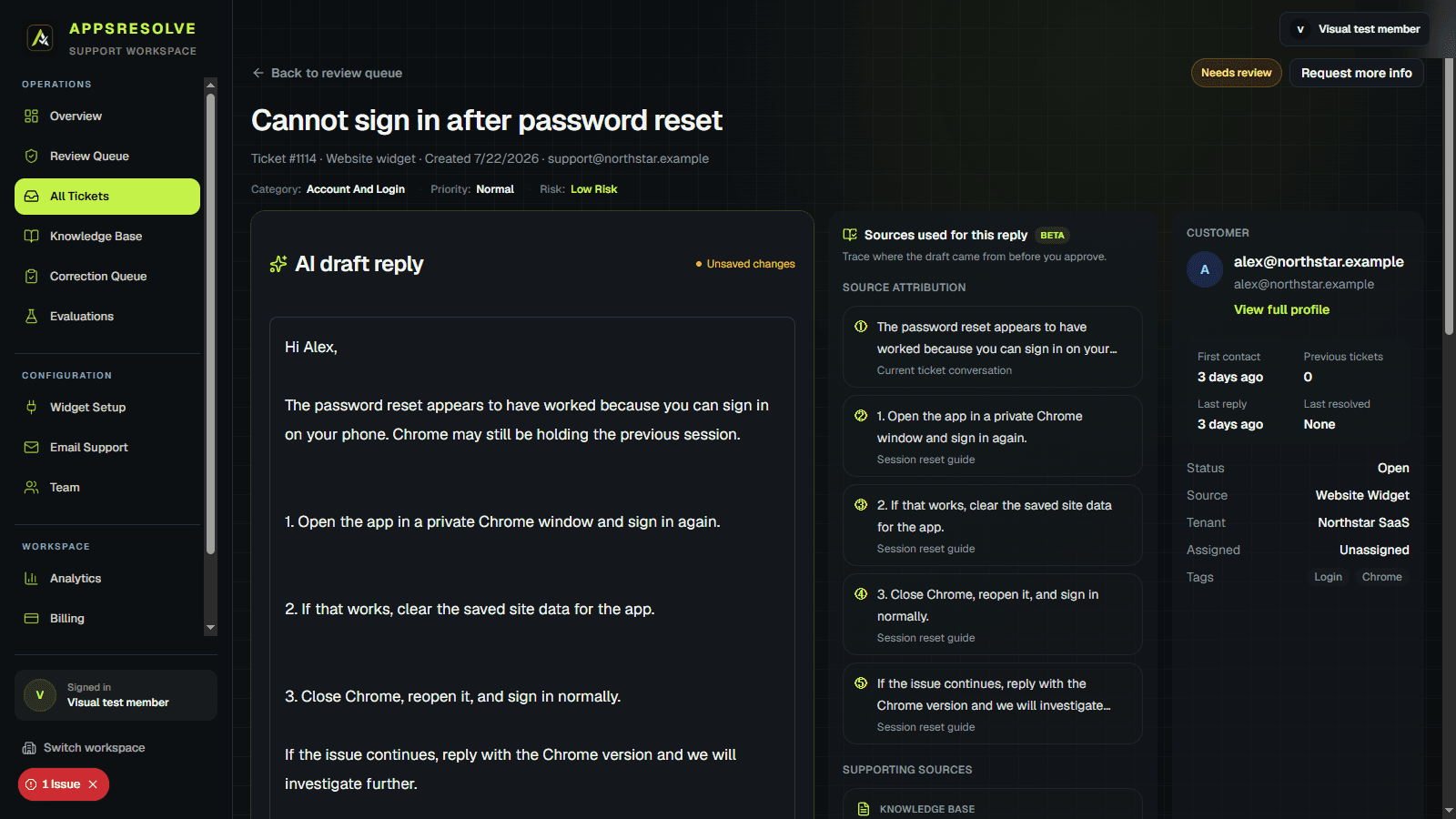
Fictional review workspace. Source attribution stays visible so product and knowledge issues are easier to spot.
AI-prepared category and priority stay with the ticket so reviewers can validate the label instead of rebuilding reporting context later.
Reopened tickets, escalations, correction reasons, and documentation gaps reveal where the first answer or underlying product experience needs work.
The customer thread, approved source, final reply, and bug-report evidence remain connected when a recurring topic becomes a product decision.
Each step preserves the customer request, organization, evidence, and human decision.
Bring email and widget requests into one organization-scoped queue.
Review the suggested category, priority, knowledge match, and escalation signals.
Use current queue and analytics metrics to inspect processed volume, reopen work, corrections, escalations, and documentation gaps.
Review categories and related tickets over a defined period. Current automatic cross-ticket clustering is not yet available.
Update product guidance, clarify a workflow, create a bug report, or change support routing based on verified evidence.
Ticket volume by topic is a starting point, not a product conclusion. A rising integration category could mean a defect, a confusing setup screen, an outdated article, or a new customer segment. Read representative threads and compare the evidence before deciding what changed.
Repeated symptoms across accounts are stronger when the environment, application version, timestamps, failed action, and workaround are preserved. AppsResolve can turn an individual thread into a structured bug report today. Automatic grouping of differently worded tickets into one recurring issue is a planned capability, not a current claim.
Questions about a feature can signal more than missing documentation. Compare where customers become stuck, the terms they use, and whether the interface suggests a different mental model. The right action may be a clearer label or safer default rather than another article.
The current AppsResolve analytics page reports documentation gaps and documentation match rate. Correction reasons can also show when a cited source is incomplete or stale. Those signals create a reviewable maintenance list instead of relying on memory after a difficult week.
AppsResolve stores priority and support context but does not currently publish a sentiment-trend dashboard. Teams that need sentiment reporting today should use a platform that provides it or export a carefully defined dataset. Do not infer customer health from a single frustrated message without account and issue context.
A useful trend review ends with an owner and a specific action: fix a confirmed defect, improve an article, change onboarding, add a validation message, or gather more evidence. Link the decision back to the support examples so the team can check whether the change reduces repeat work.
AppsResolve currently measures the review workflow and preserves ticket categories and technical context. It does not yet provide native time-series charts, sentiment trends, or automatic recurring-issue clusters.
It is the practice of reviewing ticket topics, volume, repeat contacts, escalation, corrections, and knowledge gaps over time to identify product and support changes worth making.
Yes. Tickets can carry AI-prepared category and priority data for a reviewer to validate in the support workflow.
Not yet. It preserves categories, threads, escalations, and bug-report evidence, but automatic semantic clustering across differently worded tickets is not a current shipped capability.
No native sentiment-trend dashboard is currently published. Priority and ticket context are available, but teams needing sentiment analytics today should evaluate a dedicated reporting capability.
Current reporting includes processed tickets, draft acceptance, edit distance, draft-to-send time, reopened tickets, escalations, correction work, documentation gaps, and documentation match rate.
Verify that the examples share the same behavior, preserve affected context and unknowns, and create a structured bug report with expected and observed results, impact, environment, and reproduction evidence.
See a practical method for grouping repeated customer symptoms without overstating automation.
Read moreTurn a verified technical thread into an engineering-ready issue.
Read moreUse a repeatable escalation framework for product teams.
Read moreThe agent answers from approved knowledge. Unknown questions become tickets. Suggested knowledge never publishes itself.