
Preserve comparable signals
Category, priority, customer wording, environment, knowledge matches, correction reasons, and escalation evidence stay attached to each ticket.
Build a repeatable process for finding differently worded reports of the same SaaS problem, validating the pattern, and sending product teams actionable evidence.
The workflow is useful now. Automatic semantic clustering across tickets is on the roadmap, not presented as a current AppsResolve feature.
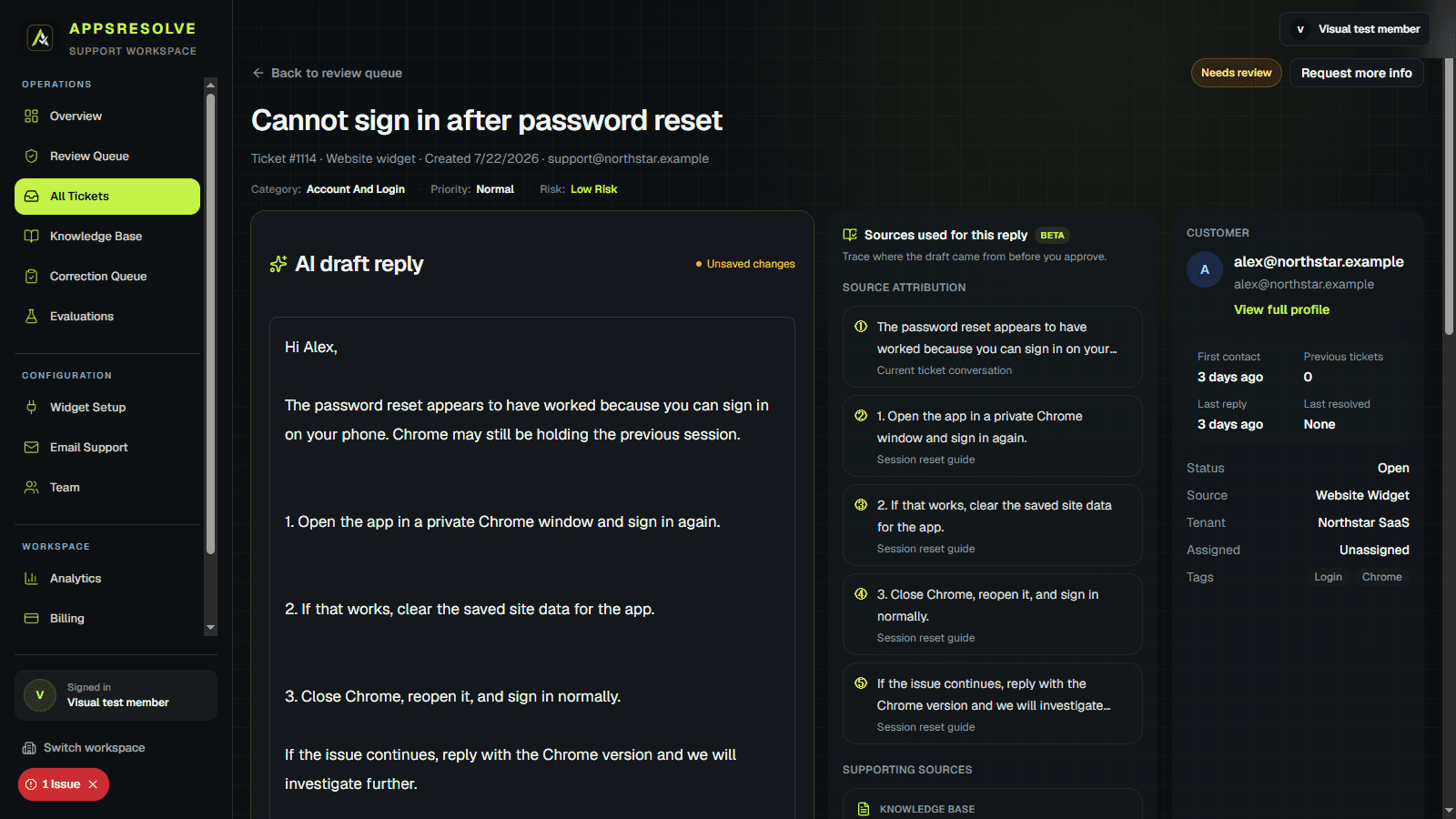
Fictional review queue item. Categories and source context help a reviewer compare related symptoms carefully.
Category, priority, customer wording, environment, knowledge matches, correction reasons, and escalation evidence stay attached to each ticket.
A reviewer checks whether similar language reflects the same underlying behavior instead of merging unrelated configuration and product problems.
Verified examples can support a structured bug report with impact, shared symptoms, reproduction evidence, workarounds, and unresolved questions.
Each step preserves the customer request, organization, evidence, and human decision.
Classify the product area and capture the failed job, not only the customer's exact phrase.
Review tickets in the same category for shared environment, action, error, timing, and workaround.
Confirm which examples reflect one underlying issue and which require separate handling.
Prepare a single issue statement with the affected accounts, common evidence, differences, and unknowns.
Assign a product, documentation, onboarding, or support-process action and watch for follow-up reports.
One customer says an upload froze. Another says the progress bar disappeared. A third reports that a file never imported. Keyword counts may split those reports even when the failed product job is identical. Useful detection compares the action, environment, outcome, and evidence.
Seven customers report failed CSV uploads using slightly different wording. The intended AppsResolve workflow is to group the signals, surface the shared pattern, and prepare an actionable issue summary. Today a reviewer can use categories, ticket context, and bug-report generation to do that work, but AppsResolve does not yet cluster the seven tickets automatically.
A CSV validation error, a network timeout, and an unsupported column format can all look like upload failure to the customer. Keep evidence that distinguishes them. A recurring-issue workflow should show why tickets belong together and let a person split the group when the underlying causes differ.
Repeated questions can expose a defect, unclear interface, missing validation, weak onboarding, or stale documentation. Do not send every repeated topic to engineering. Review the behavior against the approved product expectation and route the action to the team that can change the cause.
Record the change date and watch the same category and symptom set. A documentation update should reduce avoidable questions. A defect fix should remove the specific failure pattern. If volume remains flat, revisit the grouping or the customer-facing change.
AppsResolve currently retains technical ticket context, suggested categories and priorities, approved sources, reviewer corrections, reopen counts, escalation state, documentation gaps, and structured bug reports. Native cross-ticket semantic clusters, cluster confidence, and automatic issue summaries spanning several tickets are future capabilities.
This page describes the operating method AppsResolve is being designed to strengthen. Current product evidence supports ticket-level analysis and escalation, not automatic multi-ticket recurrence detection.
It is the process of finding multiple customer reports that likely share one underlying product, documentation, or workflow cause, then validating and summarizing the pattern.
No. Current AppsResolve data can support a reviewer-led analysis, but automatic semantic clustering across tickets is not yet a shipped feature.
A category groups a broad product area. Several different defects, setup errors, and documentation gaps can occur within the same category, so evidence still needs review.
Compare the failed job, environment, version, observed result, error, timing, workaround, and reproduction evidence, then require a person to confirm the group.
Yes. A reviewer can create a structured bug report from a technical support ticket with the issue, impact, reproduction details, environment, evidence, and unknowns.
Track the related category and symptoms after the intervention, verify whether reports decline, update customer guidance, and reopen the product investigation if the pattern persists.
Connect categories, reopen work, documentation gaps, and escalation evidence to product action.
Read moreSee how technical ticket preparation and human review fit together.
Read morePackage a verified customer problem for engineering.
Read moreThe agent answers from approved knowledge. Unknown questions become tickets. Suggested knowledge never publishes itself.