
Measure draft usefulness
Track draft acceptance, edit distance, and draft-to-send time to see whether AI preparation reduces reviewer work without replacing judgment.
Measure AI draft usefulness, reviewer effort, reopened tickets, escalations, and documentation gaps without pretending every dashboard metric is already available.
Current AppsResolve metrics focus on review quality and operational learning. Response-time, resolution-time, sentiment, and category-trend dashboards are not yet shipped.
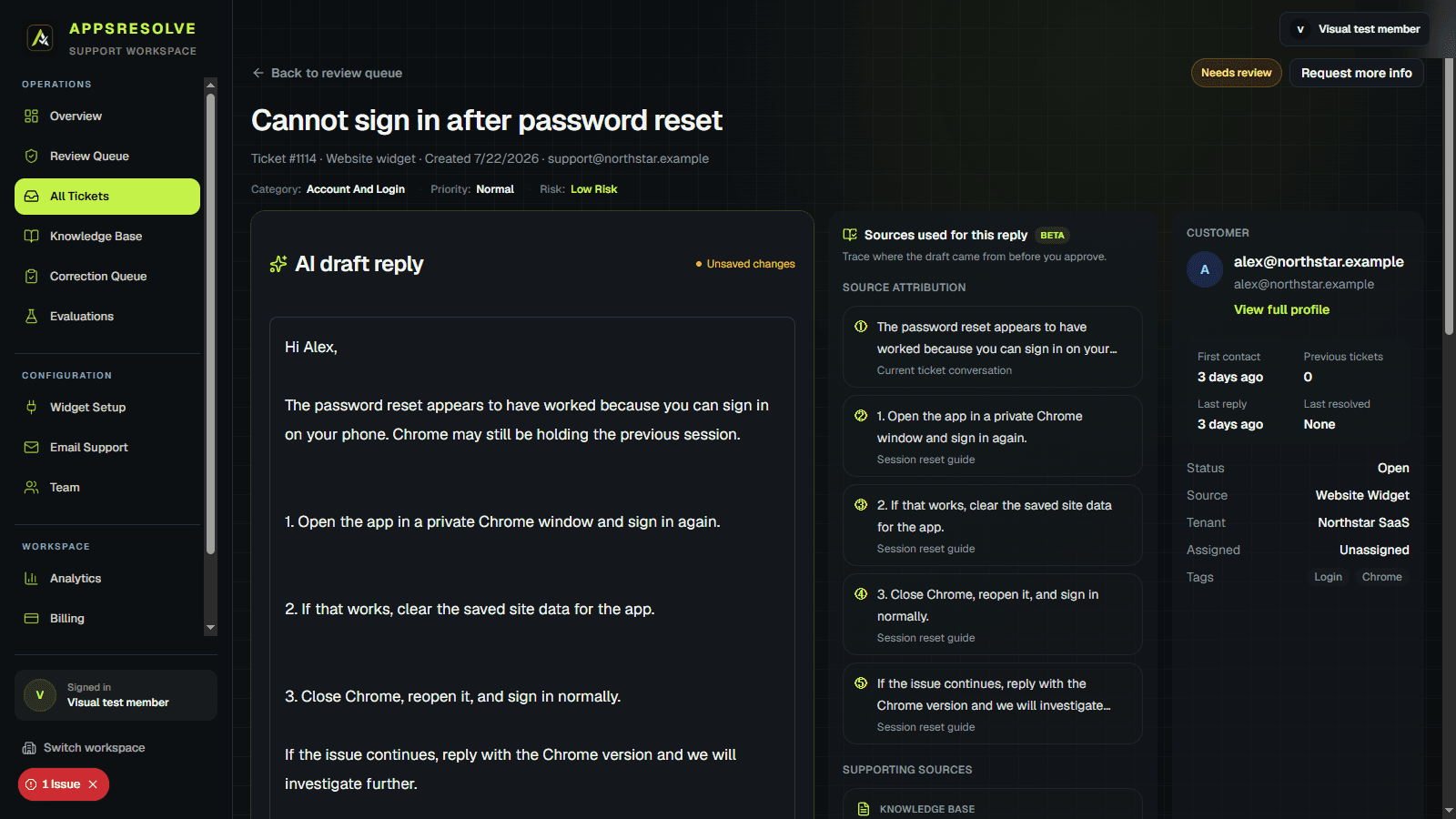
Fictional product proof. Current analytics measure review outcomes, not invented time-saved claims.
Track draft acceptance, edit distance, and draft-to-send time to see whether AI preparation reduces reviewer work without replacing judgment.
Reopened tickets, correction reasons, correction queues, and edits involving cited sources reveal where a first answer or knowledge article needs attention.
Escalated tickets, documentation gaps, and documentation match rate show where support needs a better source or engineering decision.
Each step preserves the customer request, organization, evidence, and human decision.
Choose metrics tied to a support decision, not a dashboard collection habit.
Preserve processing events, reviewer changes, delivery decisions, reopen work, escalation, and knowledge evidence.
Inspect representative tickets behind the number before treating movement as good or bad.
Change knowledge, response instructions, escalation rules, product behavior, or staffing based on verified causes.
Compare the same metric and ticket sample after the change.
The current customer analytics dashboard reports tickets processed, draft acceptance rate, median edit distance, median draft-to-send time, reopened tickets, open correction work, tickets escalated, documentation gaps, and documentation match rate. It also breaks down correction reasons, cited-source edits, correction work, and pilot or channel summaries.
A high acceptance rate can mean the drafts are helpful, but it can also hide hurried review. Edit distance shows how much wording changed, while correction reasons explain why. Sample the underlying threads so a small cosmetic edit is not treated like a corrected product claim.
A reopened ticket may reflect a weak first answer, new customer information, a delayed product fix, or a completely new question. Escalation may signal risk or simply a healthy support boundary. Read the supporting context before setting a target to drive either number down.
Many teams also need first-response time, resolution time, ticket volume over time, category trends, service targets, backlog age, support cost, workload by owner, customer satisfaction, and sentiment or urgency changes. Those are useful evaluation criteria, but they are not all current AppsResolve dashboard capabilities.
Documentation match rate and gap counts help the team see whether approved guidance covers the queue. Combine them with corrections involving cited sources. A frequently matched article that reviewers repeatedly correct may be more urgent than an article that is rarely retrieved.
Ticket volume does not equal workload. A queue of ambiguous API and integration issues can consume more skilled time than a larger queue of documented account questions. Pair counts with review time, corrections, escalations, and the people interrupted before deciding whether to automate, hire, or use managed support.
AppsResolve currently reports the review and knowledge signals listed above. This page names additional metrics teams should evaluate without presenting them as live dashboard features.
Current reporting includes processed tickets, draft acceptance, edit distance, draft-to-send time, reopened tickets, correction work, escalations, documentation gaps, documentation match rate, correction reasons, and channel or pilot summaries.
Not in the current customer analytics dashboard. First-response and resolution-time reporting are valid evaluation requirements but should not be assumed to be shipped.
Tickets retain category data, but a native multi-period category-trend visualization is not currently published.
No native sentiment analytics dashboard is currently available. Ticket priority and context are preserved, but sentiment should not be inferred as a shipped metric.
It shows how often reviewers use prepared drafts, but it should be interpreted with edit distance, correction reasons, reopen work, and ticket samples rather than treated as a standalone quality score.
Documentation gap counts, match rate, cited-source edits, and correction reasons show where an article is missing, not retrieved, incomplete, or outdated.
Turn operational signals into documentation, product, and engineering actions.
Read moreUse a reviewer-led method to validate repeated product signals.
Read moreCompare support-platform pricing and analytics scope.
Read moreThe agent answers from approved knowledge. Unknown questions become tickets. Suggested knowledge never publishes itself.